---
title: VS Code
url: https://citry.dev/ide/vscode/
description: "Highlight Citry templates and connect VS Code to the Citry language server."
---
# VS Code
The Citry extension highlights `template`, `js`, `css`, and `messages`
multiline strings inside Python components. It also supplies language modes for
standalone Citry templates and Fluent `.ftl` files, and starts one `citry-lsp`
process for each workspace folder. Formatter commands edit definite template,
JavaScript, and CSS sections while leaving Fluent and the selected Python
formatter unchanged.
`citry-lsp` 0.1.3 is public on PyPI. Install the extension's 0.1.2 release from
the [Visual Studio Marketplace](https://marketplace.visualstudio.com/items?itemName=citry-dev.citry),
[Open VSX](https://open-vsx.org/extension/citry-dev/citry), or the matching
[GitHub Release](https://github.com/citry-dev/citry/releases/tag/vscode-citry%400.1.2).
## See it in action
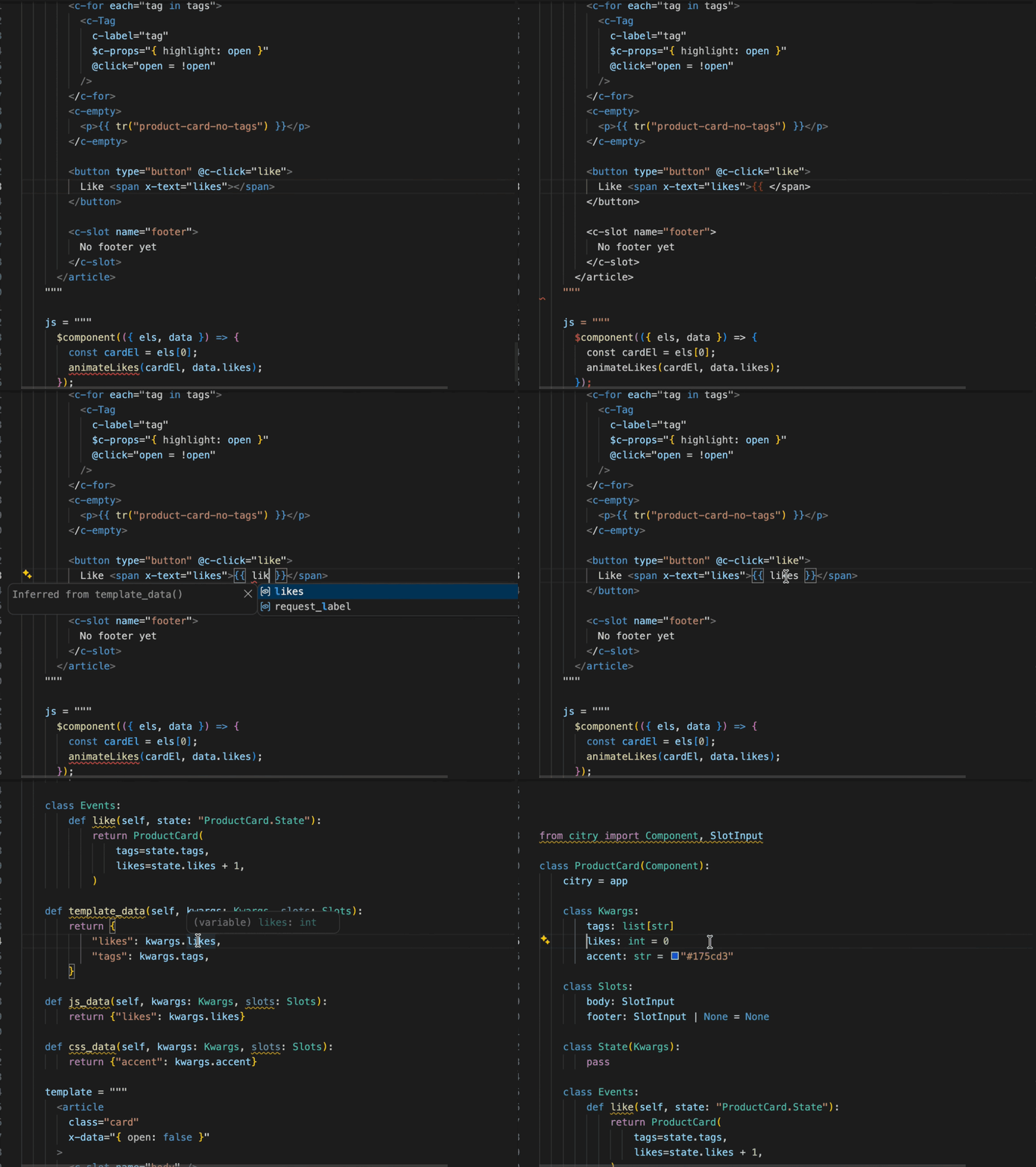
Citry completes registered components and their inputs without leaving the
Python file:
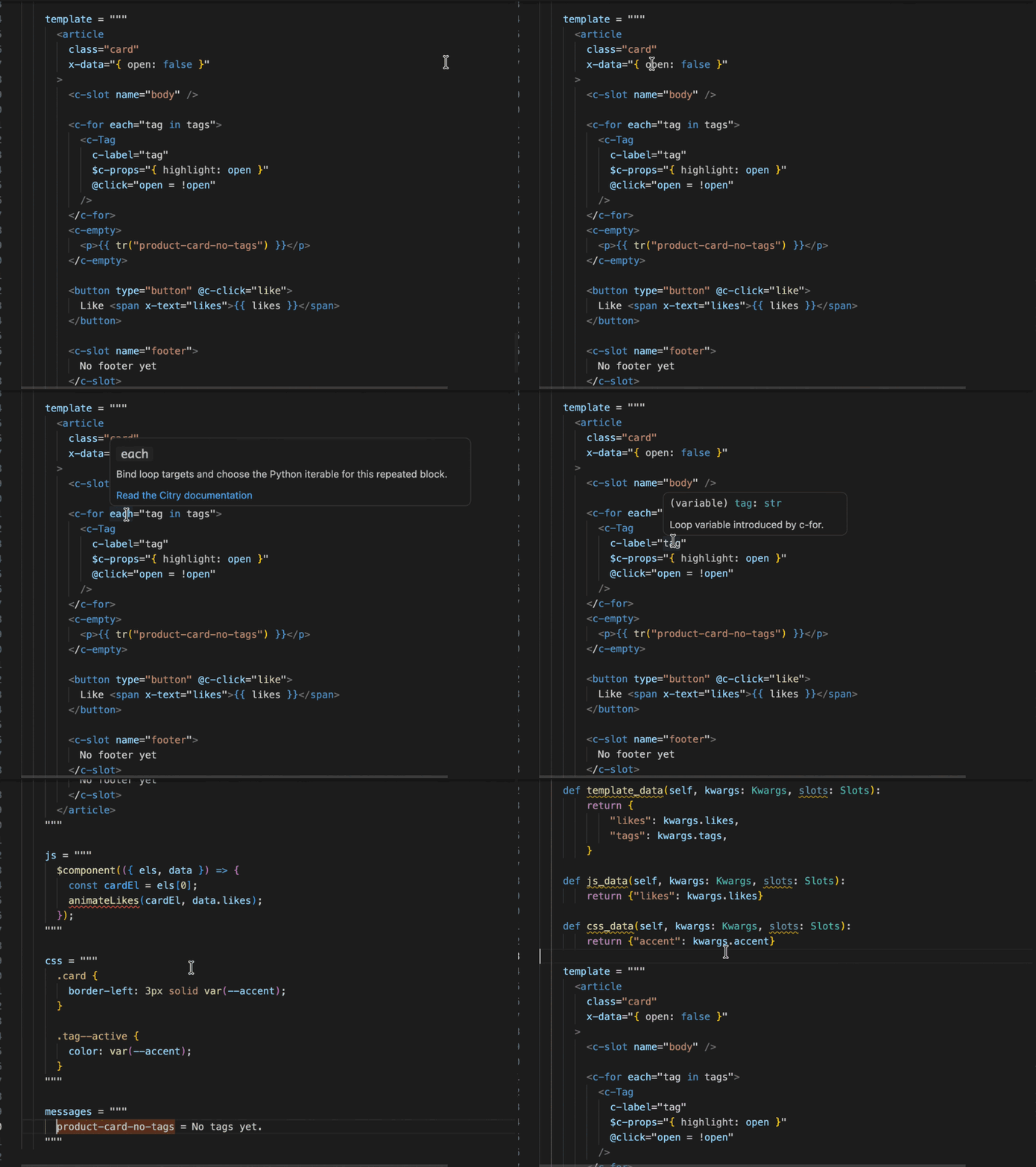
Hover hints explain template values, while references and navigation connect
them to their Python definitions:
## Install the language server
Install `citry-lsp` in the same Python environment as the Citry project:
```console
python -m pip install citry-lsp
```
Keeping the server in the project environment lets it import the registered
component catalog. An isolated server can still check syntax, but it cannot
know the application's component names, inputs, or slots.
Install **Citry** from the
[Visual Studio Marketplace](https://marketplace.visualstudio.com/items?itemName=citry-dev.citry)
or [Open VSX](https://open-vsx.org/extension/citry-dev/citry). Cursor, Windsurf,
VSCodium, and other compatible desktop forks can use the Open VSX release. The
same qualified VSIX is attached to the
[GitHub Release](https://github.com/citry-dev/citry/releases/tag/vscode-citry%400.1.2).
## Select the registry target
Set `citry.app` to the `module:attribute` path of either the project's
[`Citry`](/reference/citry/#citry-citry) instance or a reusable
[`ComponentLibrary`](/reference/component-libraries/#citry-componentlibrary):
```json
{
"citry.app": "myproject.app:citry_app"
}
```
For example, select the Citry UI library directly while working without a host
application:
```json
{
"citry.app": "citry_ui:__citry_library__"
}
```
The library form creates an isolated registry with Citry's built-ins and that
library. It does not include host-application components, configuration, or
host-provided extensions. If the library requires one of those extensions,
expose a configured `Citry` instance that installs it and select that instance
instead.
The extension normally follows the interpreter selected by Microsoft's Python
extension. Set `citry.python` to an explicit executable when that integration
is unavailable:
```json
{
"citry.python": "/path/to/project/.venv/bin/python"
}
```
If importing the selected app needs environment variables, point
`citry.envFile` to a dotenv file:
```json
{
"citry.app": "myproject.app:citry_app",
"citry.envFile": "${workspaceFolder}/.env"
}
```
Relative paths resolve from the workspace folder, and file values override
variables inherited by the Extension Host. Citry applies them only to its
isolated app-discovery worker; it does not change the environment of the
language server, Python extension, terminal, application server, or tests.
Saving, creating, or deleting the file automatically reloads the component
registry. A configured file that is missing or malformed keeps syntax-only
features available and explains the setup failure in **Citry: Show Language
Server Status**. Citry's environment adapter does not print parsed values.
For Django, include settings needed before importing the selected target. The
language server imports that module directly and does not run `manage.py`:
```ini
DJANGO_SETTINGS_MODULE=myproject.settings
DJANGO_SECRET_KEY=editor-development-secret
```
With no app configured, the status bar reports **syntax only**. Definite
inline templates and files explicitly using the Citry Template language are
still checked, but unknown components and their contracts are not inferred.
## Complete Alpine and component JavaScript
In a registry-owned component template, Citry connects Alpine expressions to
the component's browser data:
```citry
class Search(Component):
class JsData:
query: str
result_count: int
class State:
page: int
template = """
"""
```
Top-level `JsData` names complete in `x-*`, `@*`, and `:*` values. Hover shows
their JSON-derived JavaScript type, and **Go to Definition**, **Go to
Declaration**, and **Find All References** connect them to the exact Python
field or a conservatively inferred `js_data()` dict key. Public Events
`State` fields receive the same navigation through `$state`.
The component's direct `js` or resolved `js_file` receives matching types for
the complete `$component` callback context. Direct synchronous writes to
`scope` become typed Alpine names, and `x-for` bindings receive
iterable-derived types and exact navigation. A static
`$component({ props, init })` declaration also types its read-only `props`.
VS Code's installed JavaScript service supplies ordinary JavaScript member
completion, hover, and definitions; Citry keeps the Python-backed origins
authoritative. Unknown Alpine roots are errors by default through the shared
Citry lint policy. Free names inside a `$component` initializer are also
errors by default, which catches a context value such as `scope` when it was
used but not destructured. Configure the severity or real host-provided
globals through `LintSettings`; see [Template linting](/ide/template-linting/).
Hovering `$component`, a destructured callback value, or a Citry Alpine magic
such as `$sendEvent`, `$loading`, or `$error` shows its Citry contract and a
link to the matching browser API reference. Handler-name completion opens
inside the literal arguments to `sendEvent`, `$sendEvent`, `$loading`, and
`$error`, including from an empty string.
A literal `sendEvent()` or `$sendEvent()` name, a declarative `@c-*` handler,
and a handler passed to `$loading()` or `$error()` must match an effective
Python event handler and navigate to that method. Dynamic names are left open,
as are all `onEvent()` and `$onEvent()` names.
Direct `$c-props` objects on statically resolved child components validate
unknown keys, required props, and proven value types against the child's
static `$component({props})` declaration. A prop key hovers and navigates to
that declaration. A spread keeps explicit keys checkable but suppresses a
missing-required conclusion; dynamic targets and `c-$c-props` remain
unproven. When a `JsData` annotation or known literal value cannot cross
Citry's strict JSON wire, Citry reports `citry.js-data.unsupported-type` as a
warning and lets JavaScript tooling treat that value as `unknown`.
## Navigate i18n messages and profiles
When the selected application configures i18n, Citry uses its checked catalog
index across Python, templates, Fluent, Alpine, and component JavaScript.
Literal message IDs complete and navigate from `tr()`,
``, `self.i18n.tr()`,
`Component.I18n.client_messages`, `$i18n.tr()`, and the injected component
`i18n` service. Checked `$c-tr:message.output[target]` directives and bounded
`i18n.bind({ message: "...", output: "..." })` calls use the same index. Go to
definition on a `$c-tr` message opens the selected message value, or the exact
Fluent attribute when the directive includes `.output`. Hover shows the
selected output, its typed direct and
transitive parameters, translator descriptions, and defining owner. The
catalog belongs to the selected Citry application, so a definition may live
in another component, another Python file, or a configured catalog package.
Hover an argument name such as `count` in
`tr("account-unread", count=value)` to see its `@param` type and description.
Go to definition on that argument to open the exact `@param` declaration.
The same rule works in template and Python `tr()` calls, Alpine `$i18n.tr()`,
the injected component JavaScript `i18n.tr()`, and literal `` values
and fills.
Named formatter and parser profiles complete in the matching operation, such
as `fmt.number(..., format="...")`, `self.i18n.parse.percent(...)`, and
`$i18n.format.currency(...)`. Template `fmt` methods include their call
signatures and return types. A misspelled template method or a literal profile
that is not registered for that exact operation is an error. `$i18n` and the
`i18n` value in a `$component`
callback include the nested `context`, `format`, and `parse` APIs. Public
Fluent message references navigate to the same defining source; private term
references navigate within their own `messages` block.
The live diagnostics use the same Rust Fluent parser and checked app catalog.
They report unsupported `@param` types, unknown literal keys or profiles,
missing, extra, or provably mistyped message arguments, and mismatched
`` values or fills. `$c-tr` values receive the same named-input
checks, and malformed directive names such as `$c-tr:`, `$c-tr:notice[]`, or
`$c-tr:notice.` are errors before rendering. Component inputs complete in
both their static
form (`client`) and their expression form (`c-client`). `$i18n` receives
semantic help only inside a statically known client-enabled ``
provider; a server-only nested provider blocks that scope.
These features need `citry.app`, because syntax-only mode has no complete
catalog or profile registry. Fluent syntax coloring itself remains available
without the application index. Static checks follow literal message IDs,
literal profile names, and statically named argument-object keys. A dynamic
message ID or computed argument object remains a runtime responsibility.
## Navigate from CSS variables to Python data
When the selected registry owns a component's CSS, Citry connects a
`var(--name)` use to the Python data that produces it:
```citry
from citry import Component
class Chart(Component):
class CssData:
chart_height: str
css = """
.chart {
height: var(--chart_height);
}
"""
```
Inside `var(--...)`, completion offers exact `CssData` names. Hover shows the
Python producer, **Go to Definition** and **Go to Declaration** open its field,
and **Find All References** lists uses in that physical stylesheet. The same
features work for direct string keys inferred conservatively from
`css_data()`, so `{"row-color": value}` is available as `--row-color`.
Both direct `css` literals and resolved `css_file` files are supported. A CSS
file shared by several components exposes only names supplied by every proven
owner. Saving or synchronizing a Python edit rechecks the schema and asset
owner before Citry returns navigation.
Citry leaves other custom properties alone. A value may come from an ancestor,
the host page, a theme, JavaScript, an extension, or another stylesheet, so an
unmatched `var(--host-token)` is not an error. VS Code's CSS service continues
to provide ordinary CSS completion, validation, and local custom-property
navigation alongside Citry's producer information.
## Associate standalone templates
Citry accepts any filename in `template_file`, so the extension does not claim
ordinary `.html` files. Add a project-specific association when appropriate:
```json
{
"files.associations": {
"templates/components/**/*.html": "citry-html"
}
}
```
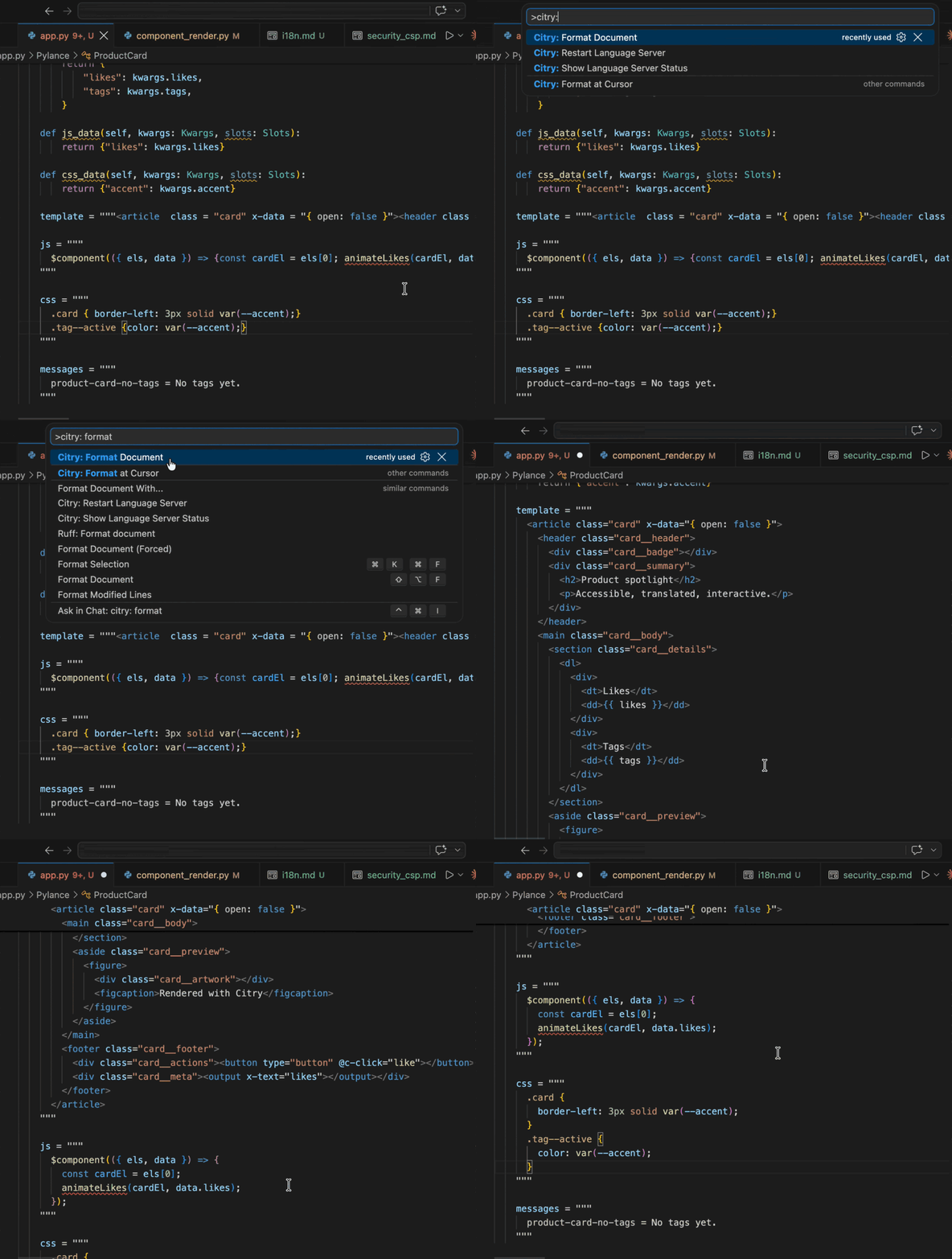
## Format Citry documents
The command palette exposes only two Citry formatting commands:
- **Citry: Format Document** formats every definite direct `template`, `js`,
and `css` literal in the current Python file.
- **Citry: Format at Cursor** formats only the direct literal body containing
the cursor.
Formatting expands Citry/HTML structure and formats embedded JavaScript and
CSS while preserving readable Python triple-quoted strings:
The commands do not format `messages` blocks or standalone `.ftl` files.
Fluent syntax highlighting is available in both places, but Citry does not yet
define a Fluent formatting contract.
Both include Citry/HTML structure and Python expressions, eligible direct
JavaScript and CSS, and eligible `
 Hover hints explain template values, while references and navigation connect
them to their Python definitions:
Hover hints explain template values, while references and navigation connect
them to their Python definitions:
 ## Install the language server
Install `citry-lsp` in the same Python environment as the Citry project:
```console
python -m pip install citry-lsp
```
Keeping the server in the project environment lets it import the registered
component catalog. An isolated server can still check syntax, but it cannot
know the application's component names, inputs, or slots.
Install **Citry** from the
[Visual Studio Marketplace](https://marketplace.visualstudio.com/items?itemName=citry-dev.citry)
or [Open VSX](https://open-vsx.org/extension/citry-dev/citry). Cursor, Windsurf,
VSCodium, and other compatible desktop forks can use the Open VSX release. The
same qualified VSIX is attached to the
[GitHub Release](https://github.com/citry-dev/citry/releases/tag/vscode-citry%400.1.2).
## Select the registry target
Set `citry.app` to the `module:attribute` path of either the project's
[`Citry`](/reference/citry/#citry-citry) instance or a reusable
[`ComponentLibrary`](/reference/component-libraries/#citry-componentlibrary):
```json
{
"citry.app": "myproject.app:citry_app"
}
```
For example, select the Citry UI library directly while working without a host
application:
```json
{
"citry.app": "citry_ui:__citry_library__"
}
```
The library form creates an isolated registry with Citry's built-ins and that
library. It does not include host-application components, configuration, or
host-provided extensions. If the library requires one of those extensions,
expose a configured `Citry` instance that installs it and select that instance
instead.
The extension normally follows the interpreter selected by Microsoft's Python
extension. Set `citry.python` to an explicit executable when that integration
is unavailable:
```json
{
"citry.python": "/path/to/project/.venv/bin/python"
}
```
If importing the selected app needs environment variables, point
`citry.envFile` to a dotenv file:
```json
{
"citry.app": "myproject.app:citry_app",
"citry.envFile": "${workspaceFolder}/.env"
}
```
Relative paths resolve from the workspace folder, and file values override
variables inherited by the Extension Host. Citry applies them only to its
isolated app-discovery worker; it does not change the environment of the
language server, Python extension, terminal, application server, or tests.
Saving, creating, or deleting the file automatically reloads the component
registry. A configured file that is missing or malformed keeps syntax-only
features available and explains the setup failure in **Citry: Show Language
Server Status**. Citry's environment adapter does not print parsed values.
For Django, include settings needed before importing the selected target. The
language server imports that module directly and does not run `manage.py`:
```ini
DJANGO_SETTINGS_MODULE=myproject.settings
DJANGO_SECRET_KEY=editor-development-secret
```
With no app configured, the status bar reports **syntax only**. Definite
inline templates and files explicitly using the Citry Template language are
still checked, but unknown components and their contracts are not inferred.
## Complete Alpine and component JavaScript
In a registry-owned component template, Citry connects Alpine expressions to
the component's browser data:
```citry
class Search(Component):
class JsData:
query: str
result_count: int
class State:
page: int
template = """
"""
```
Top-level `JsData` names complete in `x-*`, `@*`, and `:*` values. Hover shows
their JSON-derived JavaScript type, and **Go to Definition**, **Go to
Declaration**, and **Find All References** connect them to the exact Python
field or a conservatively inferred `js_data()` dict key. Public Events
`State` fields receive the same navigation through `$state`.
The component's direct `js` or resolved `js_file` receives matching types for
the complete `$component` callback context. Direct synchronous writes to
`scope` become typed Alpine names, and `x-for` bindings receive
iterable-derived types and exact navigation. A static
`$component({ props, init })` declaration also types its read-only `props`.
VS Code's installed JavaScript service supplies ordinary JavaScript member
completion, hover, and definitions; Citry keeps the Python-backed origins
authoritative. Unknown Alpine roots are errors by default through the shared
Citry lint policy. Free names inside a `$component` initializer are also
errors by default, which catches a context value such as `scope` when it was
used but not destructured. Configure the severity or real host-provided
globals through `LintSettings`; see [Template linting](/ide/template-linting/).
Hovering `$component`, a destructured callback value, or a Citry Alpine magic
such as `$sendEvent`, `$loading`, or `$error` shows its Citry contract and a
link to the matching browser API reference. Handler-name completion opens
inside the literal arguments to `sendEvent`, `$sendEvent`, `$loading`, and
`$error`, including from an empty string.
A literal `sendEvent()` or `$sendEvent()` name, a declarative `@c-*` handler,
and a handler passed to `$loading()` or `$error()` must match an effective
Python event handler and navigate to that method. Dynamic names are left open,
as are all `onEvent()` and `$onEvent()` names.
Direct `$c-props` objects on statically resolved child components validate
unknown keys, required props, and proven value types against the child's
static `$component({props})` declaration. A prop key hovers and navigates to
that declaration. A spread keeps explicit keys checkable but suppresses a
missing-required conclusion; dynamic targets and `c-$c-props` remain
unproven. When a `JsData` annotation or known literal value cannot cross
Citry's strict JSON wire, Citry reports `citry.js-data.unsupported-type` as a
warning and lets JavaScript tooling treat that value as `unknown`.
## Navigate i18n messages and profiles
When the selected application configures i18n, Citry uses its checked catalog
index across Python, templates, Fluent, Alpine, and component JavaScript.
Literal message IDs complete and navigate from `tr()`,
`
## Install the language server
Install `citry-lsp` in the same Python environment as the Citry project:
```console
python -m pip install citry-lsp
```
Keeping the server in the project environment lets it import the registered
component catalog. An isolated server can still check syntax, but it cannot
know the application's component names, inputs, or slots.
Install **Citry** from the
[Visual Studio Marketplace](https://marketplace.visualstudio.com/items?itemName=citry-dev.citry)
or [Open VSX](https://open-vsx.org/extension/citry-dev/citry). Cursor, Windsurf,
VSCodium, and other compatible desktop forks can use the Open VSX release. The
same qualified VSIX is attached to the
[GitHub Release](https://github.com/citry-dev/citry/releases/tag/vscode-citry%400.1.2).
## Select the registry target
Set `citry.app` to the `module:attribute` path of either the project's
[`Citry`](/reference/citry/#citry-citry) instance or a reusable
[`ComponentLibrary`](/reference/component-libraries/#citry-componentlibrary):
```json
{
"citry.app": "myproject.app:citry_app"
}
```
For example, select the Citry UI library directly while working without a host
application:
```json
{
"citry.app": "citry_ui:__citry_library__"
}
```
The library form creates an isolated registry with Citry's built-ins and that
library. It does not include host-application components, configuration, or
host-provided extensions. If the library requires one of those extensions,
expose a configured `Citry` instance that installs it and select that instance
instead.
The extension normally follows the interpreter selected by Microsoft's Python
extension. Set `citry.python` to an explicit executable when that integration
is unavailable:
```json
{
"citry.python": "/path/to/project/.venv/bin/python"
}
```
If importing the selected app needs environment variables, point
`citry.envFile` to a dotenv file:
```json
{
"citry.app": "myproject.app:citry_app",
"citry.envFile": "${workspaceFolder}/.env"
}
```
Relative paths resolve from the workspace folder, and file values override
variables inherited by the Extension Host. Citry applies them only to its
isolated app-discovery worker; it does not change the environment of the
language server, Python extension, terminal, application server, or tests.
Saving, creating, or deleting the file automatically reloads the component
registry. A configured file that is missing or malformed keeps syntax-only
features available and explains the setup failure in **Citry: Show Language
Server Status**. Citry's environment adapter does not print parsed values.
For Django, include settings needed before importing the selected target. The
language server imports that module directly and does not run `manage.py`:
```ini
DJANGO_SETTINGS_MODULE=myproject.settings
DJANGO_SECRET_KEY=editor-development-secret
```
With no app configured, the status bar reports **syntax only**. Definite
inline templates and files explicitly using the Citry Template language are
still checked, but unknown components and their contracts are not inferred.
## Complete Alpine and component JavaScript
In a registry-owned component template, Citry connects Alpine expressions to
the component's browser data:
```citry
class Search(Component):
class JsData:
query: str
result_count: int
class State:
page: int
template = """
"""
```
Top-level `JsData` names complete in `x-*`, `@*`, and `:*` values. Hover shows
their JSON-derived JavaScript type, and **Go to Definition**, **Go to
Declaration**, and **Find All References** connect them to the exact Python
field or a conservatively inferred `js_data()` dict key. Public Events
`State` fields receive the same navigation through `$state`.
The component's direct `js` or resolved `js_file` receives matching types for
the complete `$component` callback context. Direct synchronous writes to
`scope` become typed Alpine names, and `x-for` bindings receive
iterable-derived types and exact navigation. A static
`$component({ props, init })` declaration also types its read-only `props`.
VS Code's installed JavaScript service supplies ordinary JavaScript member
completion, hover, and definitions; Citry keeps the Python-backed origins
authoritative. Unknown Alpine roots are errors by default through the shared
Citry lint policy. Free names inside a `$component` initializer are also
errors by default, which catches a context value such as `scope` when it was
used but not destructured. Configure the severity or real host-provided
globals through `LintSettings`; see [Template linting](/ide/template-linting/).
Hovering `$component`, a destructured callback value, or a Citry Alpine magic
such as `$sendEvent`, `$loading`, or `$error` shows its Citry contract and a
link to the matching browser API reference. Handler-name completion opens
inside the literal arguments to `sendEvent`, `$sendEvent`, `$loading`, and
`$error`, including from an empty string.
A literal `sendEvent()` or `$sendEvent()` name, a declarative `@c-*` handler,
and a handler passed to `$loading()` or `$error()` must match an effective
Python event handler and navigate to that method. Dynamic names are left open,
as are all `onEvent()` and `$onEvent()` names.
Direct `$c-props` objects on statically resolved child components validate
unknown keys, required props, and proven value types against the child's
static `$component({props})` declaration. A prop key hovers and navigates to
that declaration. A spread keeps explicit keys checkable but suppresses a
missing-required conclusion; dynamic targets and `c-$c-props` remain
unproven. When a `JsData` annotation or known literal value cannot cross
Citry's strict JSON wire, Citry reports `citry.js-data.unsupported-type` as a
warning and lets JavaScript tooling treat that value as `unknown`.
## Navigate i18n messages and profiles
When the selected application configures i18n, Citry uses its checked catalog
index across Python, templates, Fluent, Alpine, and component JavaScript.
Literal message IDs complete and navigate from `tr()`,
` The commands do not format `messages` blocks or standalone `.ftl` files.
Fluent syntax highlighting is available in both places, but Citry does not yet
define a Fluent formatting contract.
Both include Citry/HTML structure and Python expressions, eligible direct
JavaScript and CSS, and eligible `
The commands do not format `messages` blocks or standalone `.ftl` files.
Fluent syntax highlighting is available in both places, but Citry does not yet
define a Fluent formatting contract.
Both include Citry/HTML structure and Python expressions, eligible direct
JavaScript and CSS, and eligible `